Yesterday, British Columbia elected a Conservative government. Election night results have the Conservative Party with a clear majority of 64 seats, the NDP with 27 seats, and the Green Party with two seats. Two weeks ago I introduces new election cartograms for British Columbia that visualize election outcomes by representing each constituency with a hexagon, roughly in geographic proximity to each other, but correcting for the vast differences in geographic size. Below are the new election cartograms with the results of yesterday's election.
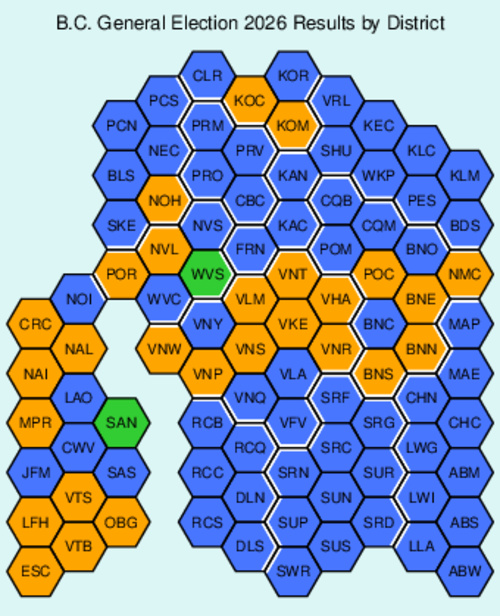
click on image for high-resolution PDF version
The chart below shows which seats changed hands: a cluster of four ridings on Vancouver Island, and wave of ridings across Richmond, Delta, parts of Vancouver and Burnaby, Surrey, Maple Ridge, Port Coquitlam. These are mostly ridings that straddle urban and suburban areas, and are natural "battleground" ridings. With the swing in the popular vote, these flipped from the NDP to the Conservatives. Curiously, one riding (Courtenay-Comox) flipped to the NDP, but with less than 700 votes difference.
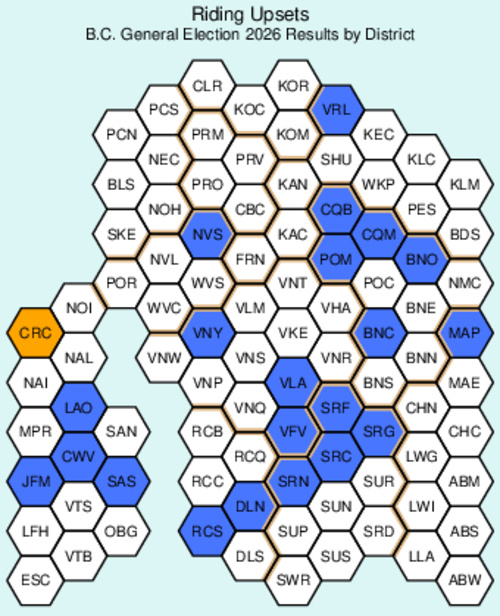
click on image for high-resolution PDF version
A first-past-the-post system exaggerates relative strengths of political parties, and thus the last diagram below shows the "true" colour of British Columbia. with orange and blue and green mixed in proportion the the parties' strengths. The colour shades remain more nuanced, and especially Vancouver Island remains much lighter coloured than other parts of the province. Vote splitting among progressive voters favoured the Conservative Party, quite in reverse what NDP tactitians anticipated with vote splitting among the right between Conservatives, Centre BC, and One BC. Instead the right-of-center vote consolidated behind the Conservatives convincingly. Voters clearly preferred a clear alternative to the incumbent government and handed the Conservative Party a strong mandate.
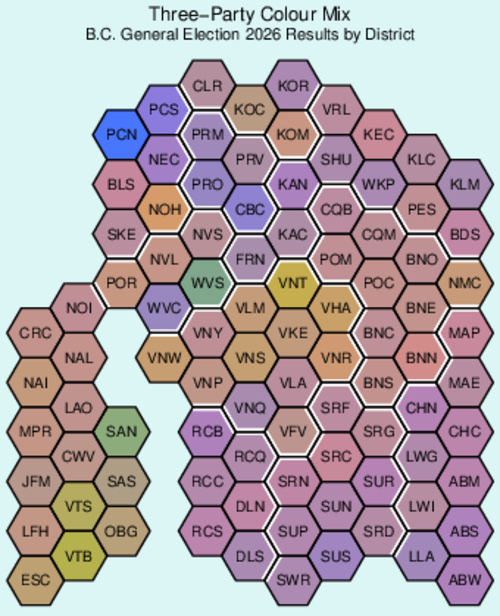
click on image for high-resolution PDF version
Despite the blue wave, British Columbia remains more divided than the election result suggests. If British Columbia had a proportional representation system, the vote would have gone 46-36-11 for Conservatives, NDP, and Green Party (using the modified Saint-Laguë method), or 47-36-10 (using the d'Hondt method). In the former the Green Party would have held the balance of power. The parties gained 48.1%, 37.4%, and 11.0%, with 1.6% and 1.5% going to other parties on the right of the political spectrum. That makes a rough 51.27ndash;48.4% vote split in the province. While Conservatives have a strong mandate to govern, the election outcome has been helped much by the electoral system. The large seats share in the Legislature will give fringe voices in the Conservative Party less leverage, which should allow the new Premier Lorne Doerkson to focus on policy-making and less on party infighting. The incoming government faces strong headwinds fiscally, and costly promises made in the election platform are not helping to bring down British Columbia's deficit and worrisome fiscal situation, which I had written about in September.