British Columbia's fiscal situation is deteriorating rapidly and needs urgent intervention. A provincial election has been called for October 24, and the candidates will need to explain what they are planning to do to restore health and discipline to B.C.'s finances. Provincial public debt is rapidly increasing, and without swift and decisive intervention the debt service will eat up larger and larger shares of the budget. Decisive action now will prevent much more painful actions in the future.
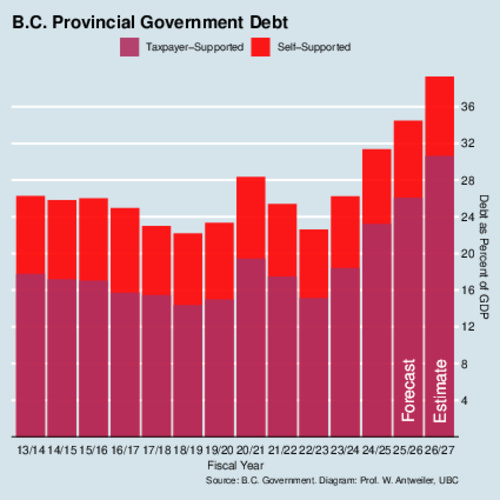
The diagram below shows that government debt in B.C. is rising quickly, with the forecasted and estimated debt-to-GDP ratio for the past and current fiscal year rising from a typical 25% level in the past to nearly 38%. This development is alarming, and can easily spiral out of control if left unchecked. The diagram shows taxpayer-supported and self-supported debt. The latter is managed by crown corporations and is not problematic. It is the taxpayer-supported debt that is rising due to large budget deficits.
click on image for high-resolution PDF version
The diagram above, and all below, express budget and debt data relative to nominal GDP. This makes these numbers comparable over time, as the dollar figures are not particularly helpful at first. Expressing everything relative to nominal GDP allows us to see how revenues and expenditures are supported relative to the size of the economy and a growing provincial population. Changing ratios over time provide an indication that there are structural changes that need addressing.
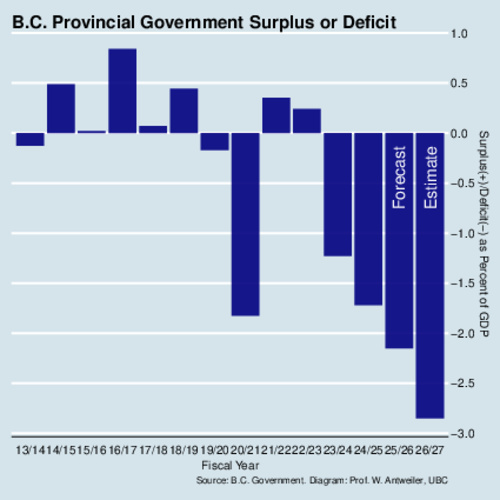
What is driving up public debt is an expanding budget deficit. Provincial finances were on a sound foundation until the pandemic hit. However, in the two years following the pandemic, the province managed to get back on track. Things started to deteriorate during fiscal year 23/24, and the situation has worsened continuously since that budget year. No corrective actions were taken. The forecast for budget year 26/27 is a budget deficit equal to 2.8% of provincial GDP. This level is unsustainable and perilous.
click on image for high-resolution PDF version
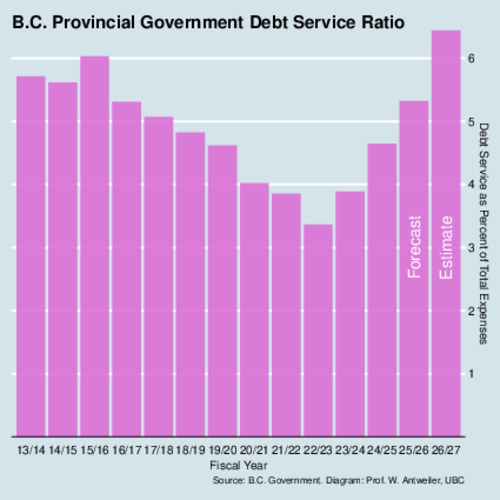
The next diagram shows what deficit accumulation brings about: a debt service spiral. When public debt rises, a larger and larger share of the available budget needs to be devoted to servicing debt, and if neither revenue nor expenditures are changed, a continuing deficit increases public debt, and more public debt needs to be serviced. Add to that the risk of interest rate increases—both due to changes in monetary policy and through a rising risk premium for BC-issued bonds—and the debt service spiral can even turn quicker than anticipated. The diagram shows that the debt service ratio fell from relative high numbers in 2015/16 down to a low level in 2023/24, primarily due to a sustained phase of low interest rates. Now the situation has changed, and already over 6% of the budget goes to servicing debt. This number is expected to increase further yet.
click on image for high-resolution PDF version
‘Swift and decisive action is needed to fix B.C.'s budget deficit.’
So how did the province end up in this precarious situation? It is always easy to blame the incumbent government for everything that goes wrong. But the situation is more nuanced. Some of the blame falls squarely on the shoulders of the government due to their actions, but there are also other factors that were outside the government's control. Where responsibility sits with the provincial government is with taking swift and decisive action when such action is needed, and here the current government has been asleep at the wheel, to use this metaphor. Candidates in the current election need to come clear about what they propose to do about the deficit: and that means raising revenue, cutting expenditures, or both. But before exploring policy interventions, let us have a closer look at how the situation emerged. Therefore, let's turn towards revenue and expenditures and track down where the problems lie. The next four diagrams provide an analysis.
click on image for high-resolution PDF version
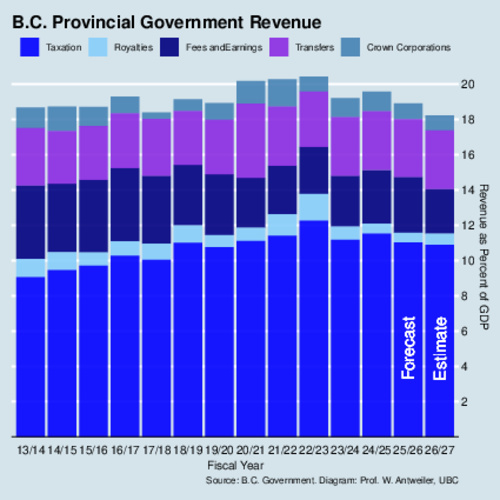
First up is a look at government revenue, expressed in the diagram above again as percentages of nominal GDP. There are five major revenue streams for the province: taxation, royalties, fees and earnings, transfers from the federal government, and revenue from crown corporations (such as B.C. Hydro). As the chart shows, the baseline has been about 19% in the past, drifting a little higher between 2021 and 2023, but now falling to bout 18%. This change is not insignificant. It is important to understand why revenues have dropped. As the chart shows, tax revenue has started to drop. Royalties have shrunk somewhat, and fees and earnings are significantly down.
click on image for high-resolution PDF version
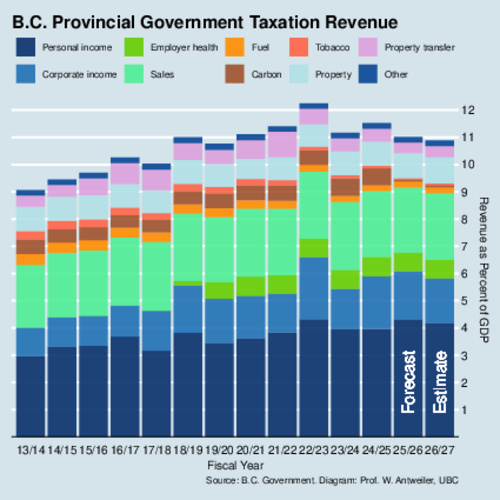
A closer look at the tax revenue shows that there has been a slight erosion over the last few years. Personal and corporate income taxes are relatively steady, and sales tax revenue (the PST) follows the business cycle. What is notably down are property transfer taxes as the housing market has slowed down. What has evaporated is the revenue from carbon pricing on motor fuels, which was suspended in April 2025. The carbon tax brought in about $2.6B in the last years before it was abandoned, and the revenue loss is about $2.3B. Canceling this tax may have been politically popular, but it was fiscally irresponsible.
click on image for high-resolution PDF version
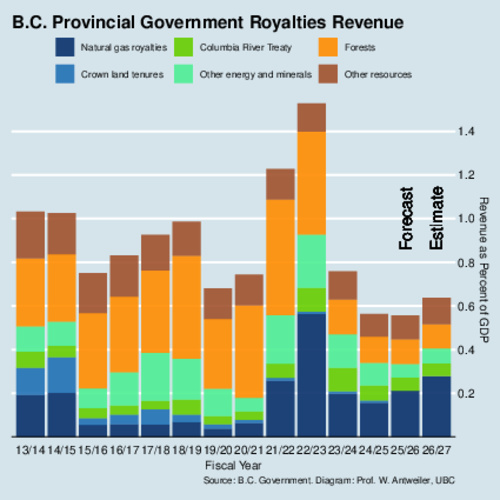
Royalties account for a relatively small share of revenues, but there has been significant revenue erosion as well. First, what stands out are the record windfalls from natural gas royalties during fiscal 22/23. This was driven by unusually high natural gas prices in world markets following Russia's atrocious invasion of Ukraine. A reform in the natural gas royalty regime is expected, and hopefully this can rake in more revenue than in the past. B.C.'s natural gas industry has matured and can contribute more to the public benefit. Second, the orange bars that represent tax revenue from forestry (stumpage fees) has been declining continuously as the industry has shrunk and suffers from the pine beetle epidemic, wild fires, and the softwood lumber dispute with the United States. So here we have lost another, give or take, 0.4% of GDP in revenue.
click on image for high-resolution PDF version
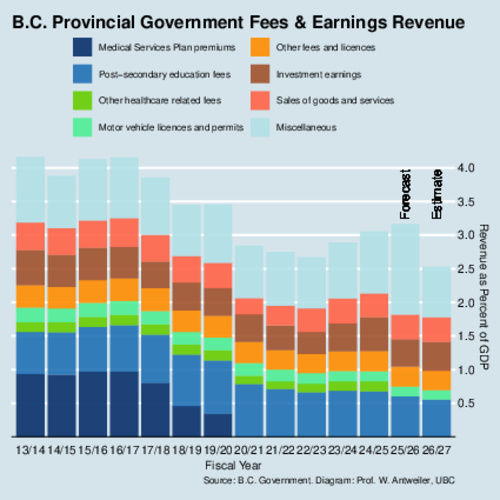
A much bigger problem for British Columbia than the erosion of royalty revenue has been the drop in fees and earnings, shown in the next diagram. B.C. discontinued the collection of the medical services premium from workers and employees. However, as an earlier diagram revealed, most of that revenue was compensated by the new employer health contribution. So give or take, this effect has canceled out.
To summarize, the revenue side reveals erosion in tax revenue (due to the drop in carbon pricing) and an erosion in royalties (primarily from the forestry sector). The first wound is a self-inflicted, while the second wound was caused by external economic forces.
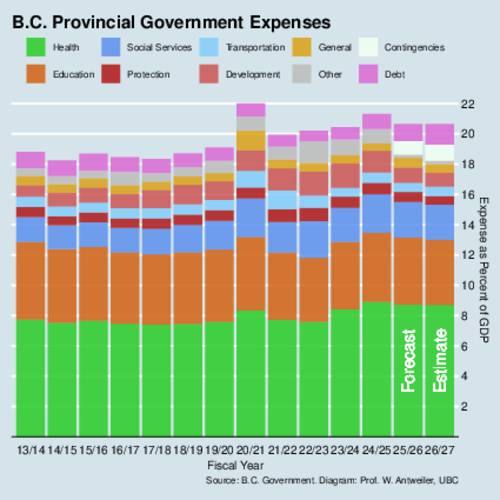
Turning to expenditures reveals other drivers of the budget deficit. Ignoring the pandemic year 20/21, the expenditure-to-GDP ratio has increased from roughly 19% from ten years ago to 21% today. That is a significant increase. There are two main culprits. The first one is rising health care costs. This reflects growing health care needs as our population is getting older, and the need to fix critical holes in health care provision. What has increased noticeably is the increase in expenditures for social services, and expenditures that are booked under "other" and need closer scrutiny as well. The debt service, which was shown in a separate diagram before, sits on top of all and has been increasingly rapidly in the last three years.
click on image for high-resolution PDF version
So here we are, with a budget deficit of 2.8% of GDP and growing. The province needs to make adjustments of about 3.2–3.5% relative to nominal GDP to return the province to a budget surplus that can help bring down public debt and reduce the debt service. Such a large gap can only be closed through a combination of increasing revenue and decreasing expenditures. The exact combination is a matter of political priorities, and here the political parties may have different prescriptions to offer. Some may lean more towards raising revenue, while other may lean more towards expenditure cuts.
What is most unhelpful in the current situation is finger-pointing. We are where we are, and no matter who runs the provincial government come November 2026, aggressive intervention is needed to steady the ship and put the sails back in the wind. The interventions will be painful. Which politician has the courage to speak truth to British Columbians about that. The natural instinct of politicians is to appease the voter with promises of an easier and more affordable life. Which politicians has the grit and chutzpah to tell voters that they have to swallow painful medicine? My fear is that neither incumbent government nor opposition have the intrepidity and fortitude to face the voters with the painful truth.
British Columbia is receiving a small windfall, but this will not permanently fix the structural problem. This windfall is from the historic $32.5B Canadian tobacco settlement through which British Columbia will receive $3.6B over the course of 18 years. The finance minister recorded a $2.6B revenue in the current fiscal year, more than what was received that year. (The accounting here is not as problematic as some suggest. The auditor general would have preferred having the entire settlement recorded in the year the settlement was announced, essentially creating an accounts-receivable item.)
‘Fixing B.C.'s budget deficit will require a mixture of revenue increases and expenditure cuts without impeding economic growth.’
So what should be done? As an economist, I have my own ideas about what works and what doesn't. The most important consideration is that any intervention to fix the budget is conducive to economic growth and does not get in the way of investing into our future. Our policies need to promote economic growth in the (sustainable!) industries of the future. Raising income taxes would likely prove counterproductive. Instead, we need to shift more from consumption to investment, and for that we need to tax consumption more. The province is already working on the "low-hanging fruit" of broadening the PST tax base by including previously exempt professional and business services, starting this October. But this measure was paused as it received the predictable push-back. I would criticize the government's approach as not going far enough. Gordon Campbell's government tried to harmonize B.C.'s federal and provincial sales tax in 2009, but failed. It led to a referendum and repeal of the tax in 2011. Despite being hugely unpopular, the HST was—and remains—economically sound. The province needs to start closing the tax base gaps between the PST and GST even if not embracing a full HST. To begin with, putting the PST on motor fuels—as is already the case with the GST—would raise between $600-$800 million. Ultimately, the province may not be able to avoid raising the PST rate, and/or raising motor fuel taxes. Raising the PST from 7% to 9% would bring in about $1.5B, keeping the tax base unchanged. Raising motor fuel taxes by 20 cents per liter would bring in another $1.5B. These are extremely unpopular things to do, but they are necessary nevertheless. But raising revenue is only one side of the coin. The other side of the coin has cutting expenditures written on it. Health care, education, and protection are indispensable. I would also be wary of cutting investment into transportation, as better (public) transportation contributes to economic growth and the needed densification of our urban areas. These areas should not become prime targets for cuts. Instead, the main target will likely be "soft" expenses—social services, natural resources and economic development, general government, and the quirky "other" category. Cutting some of these budgets will involve laying off workers, another highly unpopular move.
Where exactly to cut expenses requires analysis mostly beyond the scope of today's essay, but the most suitable target are tax credits (subsidies) to specific industries. Among my preferred targets is the "deep well royalty credit" for the natural gas industry, which has depressed tax revenues. So technically it is a revenue reduction rather than an expense. The legacy royalty system is expiring at the end of this year, and a new oil and gas royalty framework comes into effect at the start of 2017. But even with this transition, there remains a large legacy fiscal impact. Because companies accumulated billions in legacy credits before the 2022 freeze of the deep well royalty credit, these companies have still been actively drawing down unused balances to lower their current royalty payments. The new royalty system should acknowledge this shortcoming of the past and claw back some of the excess profits that the industry has earned over the past. To make the fiscal picture even more confusing, the finance ministry was caught by Business in Vancouver journalist Stefan Labbé in August 2026 with a huge budget error that was attributed to a spreadsheet error. Other subsidies could be targeted to. Concessions to LNG producers through preferential industrial electricity rates and PST exemptions for facility construction, along with specialized tax credits for LNG development, have added up to foregone revenue of many million dollars. Eliminating these specialized concessions (where it is still contractually feasible) should be a priority. The global LNG industry is financially mature, and BC taxpayers should not be asked to subsidize it. Other boutique tax credits in B.C.'s 2026 budget are also somewhat suspect, in my opinion.
‘Which political leader has the chutzpah to lead us back to sound fiscal stewardship?’
Earlier I spoke of at least 3.2% of nominal GDP as a target for policy adjustments. With an estimated GDP of $466B in 2026, this means something in the neighbourhood of $11B for budget adjustments. My sense is that about $4B–$5B need to be adjusted on the revenue side, and another $6B–$7B on the expenditure side, to balance the budget. Doable? Absolutely. Necessary? Definitely. Opportune? Not a chance. Politically feasible? All bets are off. Budgets don't fix themselves. Who has got the courage to do what is necessary? As the current government is seeking a new mandate, they should have asked for a mandate to fix what is broken. Not all of what is broken is their fault, but some of it is. Likewise, the opposition is keen on pointing out what is broken, but without coming clear about the remedies that they would prescribe. Both sides need to stop playing politics and instead describe in detail the course of actions that they would take. Then British Columbians would have a real choice. As of now, neither side is presenting a clear and workable plan. Shallow promises and vague directions are not sufficient for making informed decisions about how to fix the current budget problems. We are not in crisis territory yet, but like all wounds that fester, they eventually become infected and progress into necrosis and sepsis. The sooner we administer the antibiotics, the sooner the wound can heal.
Lastly, a technical note. The GDP ratios in all the diagrams above depend on knowing the nominal GDP, which goes into the denominator of the ratio. For the current and previous fiscal year, these numbers are not fully established yet because of reporting lags for 2025, and because 2026 is still in progress. Thus the data for fiscal year 2025/26 amount to updated forecasts, and the data for fiscal year 2026/27 amount to an estimate that may still change. So some caution is advised in reading the numbers, let alone any plans for the forthcoming fiscal years. The major unknown is often GDP growth, and the provincial government assumed 4.1% and 4.4% of growth in 2025 and 2026.
![[print]](print.png)
Recent Blog Entries
- British Columbia's public debt situation is precarious (September 27)
- Canada's sovereignty is not for sale (August 25)
- Should data centres provide demand flexibility to protect BC's electricity grid? (June 8)
- Wind power is growing in British Columbia (June 5)
- Canada needs better rail, but not high-speed rail (June 2)
- How are Canada's electric vehicle imports trending? (May 9)
- The 2026 oil shock may become larger than you think (April 30)
- Improving road safety and saving lives with Leading Pedestrian Intervals (April 2)
- Where are BC's LNG exports sailing to? (March 27)
- Driving electric has become much more beneficial (March 17)
- Today's ruling by the U.S. Supreme Court won't end Trump's trade wars (February 20)
- America's Federal Reserve must stay independent (January 13)
Topics
Months
Subscribe to RSS feed 
![[Sauder School of Business]](logo-ubc-sauder-2016.png)
![[The University of British Columbia]](logo-ubc-2016.png)