The war in the Middle East, now in its third week, has driven up crude oil prices. The Brent crude oil index has crossed the US$100/barrel mark. Gasoline prices have followed, with prices at the pump in Canada jumping up about 30 ¢/L. Diesel prices have gone up even higher. Motorists who need to put gasoline into their tanks may look with envy at their fellow motorists who are zipping by them with electric vehicles. Their cost per kilometer is hugely lower. Perhaps it's time for motorists to have a closer look at electric alternatives. Electricity is cheap in Canada, it is domestic, and it is most certainly not dependent on the turmoil in in the Middle East.
After purchase incentives were cut in early 2025, EV adoption rates in Canada have plummeted. During the last quarter of 2024, an average of just over 18% of new vehicles sold in Canada were either battery-electric vehicles (BEVs) or plug-in hybrid electric vehicles (PHEVs). As the chart below shows, by the last quarter of 2025, sales have started picking up again but are still about 7%-points below where they were in 2024.
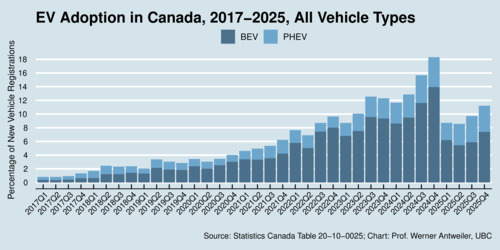
click on image for high-resolution PDF version
‘Driving electric is most advantageous in urban areas of British Columbia and Québéc.’
So how much will driving electric save you? It depends on how much you drive and where you drive. Let's have a look at an annual average driving distance of 12,800 kilometers and a vehicle with a twelve year lifetime. The electric vehicle requires 25 kilowatt-hours [kWh] per 100 kilometers, and the gasoline vehicle requires 10 liters [L] per 100 kilometers. The table below shows the 2024 electricity prices from the annual Hydro Québéc survey of retail electricity prices across Canadian cities in &textcent;/kWh. These numbers change only gradually. Gasoline prices show the 2025 average in &textcent;/L. These prices are converted into costs per kilometer for driving electric or with gasoline. The gap is substantial. In Vancouver, the price of gasoline is five times the price of electricity on a per-kilometer basis. Now multiply the cost gap with the total lifetime kilometers of the vehicle (153,600 km), and the lifetime electricity advantage is what you see in the last column of the table below, sorted in descending order from where the advantage is the largest (Vancouver) to where it is the smallest (Edmonton).
| City, Province | Electricity Price [¢/kWh] |
Gasoline Price [¢/L] |
Electricity Cost [¢/km] |
Gasoline Cost[¢/km] |
Lifetime Advantage [$] |
|---|---|---|---|---|---|
| Vancouver, BC | 12.1 | 169.4 | 3.0 | 16.9 | 21,395 |
| Montréal, QC | 8.1 | 158.0 | 2.0 | 15.8 | 21,177 |
| St. John's, NL | 14.6 | 155.0 | 3.7 | 15.5 | 18,194 |
| Moncton, NB | 16.3 | 158.0 | 4.1 | 15.8 | 18,009 |
| Winnipeg, MB | 10.5 | 136.2 | 2.6 | 13.6 | 16,873 |
| Charlottetown, PE | 19.1 | 152.8 | 4.8 | 15.3 | 16,125 |
| Ottawa, ON | 14.3 | 139.1 | 3.6 | 13.9 | 15,875 |
| Toronto, ON | 15.1 | 139.9 | 3.8 | 14.0 | 15,708 |
| Halifax, NS | 19.5 | 146.3 | 4.9 | 14.6 | 14,995 |
| Regina, SK | 17.9 | 138.6 | 4.5 | 13.9 | 14,420 |
| Calgary, AB | 23.2 | 133.4 | 5.8 | 13.3 | 11,586 |
| Edmonton, AB | 24.0 | 130.4 | 6.0 | 13.0 | 10,814 |
Electricity and gasoline prices vary substantially across Canada, but the electric advantage is always positive. A motorist in Vancouver can expect to save $20,000 over the lifetime of a vehicle, while a motorist in Edmonton only saves about half as much. The cost savings need to offset the higher purchase cost of a BEV or PHEV, and the cost of an EV charger at home. But it is clear that in many places in Canada it pays to drive electric.
The purchase price gap is shrinking. Take for example the 2026 Hyundai Kona that sells for $29,731 and the 2026 Hyundai Kona Electric that sells for $46,774. The gap is about $17,000. The Hyundai Tucson is available as a mild hybrid for $46,781 and as a plug-in hybrid for $56,081, a $9,300 gap. The PHEV version has a 51km range. The Mitsubishi Outlander PHEV is about $12,000 to $14,000 more expensive than the non-electric version, and has a 72km range. While BEVs and PHEVs are still more expensive than their gasoline counterparts in Canada, the cost difference is mostly driven by the cost of the battery. The larger the battery, the larger the cost gap. PHEV trade off a smaller battery size against the cost of an extra engine. But as PHEVs are still cheaper than comparable BEVs, they can offer all the benefits of an electric vehicle at a lower cost, minus any range anxiety. A PHEV with 72km or 80km of range will allow most motorists to drive in pure-electric mode most of the time.
To get the full benefit of driving electric, an EV charger at home is essential, This is both the most convenient option, and the lowest cost option. Plugging in your car when arriving back at home is easy, and the car will be charged up the next morning. No more wasting time at the gas station. Charging at home will also provide the nominal electricity rate by the electric utility. Using a public charger will be more expensive, and should only be used when needed. The benefits of driving electric shrink substantially when relying on public chargers only. BC Hydro, for example, charges more than double the nominal &textcent;/kWh rate for using their fast chargers. But even at 36&textcent;/kWh, driving electric costs only 9&textcent/km, compared to 20&textcent;/km for gas-powered cars.
Gasoline prices have jumped significantly in recent days as the Strait of Hormuz is blocked and millions of barrels of oil per day cannot reach international markets. In Vancouver, retail gasoline prices have topped $2 per liter. The next table shows the size of the electric vehicle advantage would if prices were to remain elevated at that level permanently.
| City, Province | Electricity Price [¢/kWh] |
Gasoline Price [¢/L] |
Electricity Cost [¢/km] |
Gasoline Cost[¢/km] |
Lifetime Advantage [$] |
|---|---|---|---|---|---|
| Vancouver, BC | 12.1 | 205.3 | 3.0 | 20.5 | 26,903 |
| Montréal, QC | 8.1 | 187.4 | 2.0 | 18.7 | 25,693 |
| Moncton, NB | 16.3 | 187.4 | 4.1 | 18.7 | 22,525 |
| St. John's, NL | 14.6 | 177.9 | 3.7 | 17.8 | 21,711 |
| Winnipeg, MB | 10.5 | 161.9 | 2.6 | 16.2 | 20,824 |
| Ottawa, ON | 14.3 | 168.2 | 3.6 | 16.8 | 20,352 |
| Charlottetown, PE | 19.1 | 180.3 | 4.8 | 18.0 | 20,348 |
| Toronto, ON | 15.1 | 169.3 | 3.8 | 16.9 | 20,221 |
| Halifax, NS | 19.5 | 168.7 | 4.9 | 16.9 | 18,440 |
| Regina, SK | 17.9 | 162.8 | 4.5 | 16.3 | 18,136 |
| Calgary, AB | 23.2 | 157.8 | 5.8 | 15.8 | 15,341 |
| Edmonton, AB | 24.0 | 152.9 | 6.0 | 15.3 | 14,277 |
‘Convenient charging at home makes driving electric the most affordable. To boost EV adoption, we need to reduce hurdles for at-home charging.’
As more and more BEV and PHEV choices are arriving at car dealerships in Canada, motorists are well advised to give them a closer look. It's okay to sit on the fence and go for a PHEV—drive electric as much as possible and drive on gasoline when it cannot be avoided. But if you decide to drive electric, a charger at home is essential to realize the full benefits. To make charging at home easier, significant hurdles need to be lowered still. Charging in rental or strata buildings, and charging where homeowners only have curbside parking, remains challenging. The key to boosting EV adoption in Canada will require removing or lowering these obstacles.
Further readings:
- Michael Grunwald: Now Is the Perfect Time to Buy an Electric Vehicle, The New York Times, March 23, 2026.
![[print]](print.png)
Recent Blog Entries
- Canada's sovereignty is not for sale (August 25)
- Should data centres provide demand flexibility to protect BC's electricity grid? (June 8)
- Wind power is growing in British Columbia (June 5)
- Canada needs better rail, but not high-speed rail (June 2)
- How are Canada's electric vehicle imports trending? (May 9)
- The 2026 oil shock may become larger than you think (April 30)
- Improving road safety and saving lives with Leading Pedestrian Intervals (April 2)
- Where are BC's LNG exports sailing to? (March 27)
- Driving electric has become much more beneficial (March 17)
- Today's ruling by the U.S. Supreme Court won't end Trump's trade wars (February 20)
- America's Federal Reserve must stay independent (January 13)
- What good are stablecoins? (19 Dec 25)
Topics
Months
Subscribe to RSS feed 
![[Sauder School of Business]](logo-ubc-sauder-2016.png)
![[The University of British Columbia]](logo-ubc-2016.png)