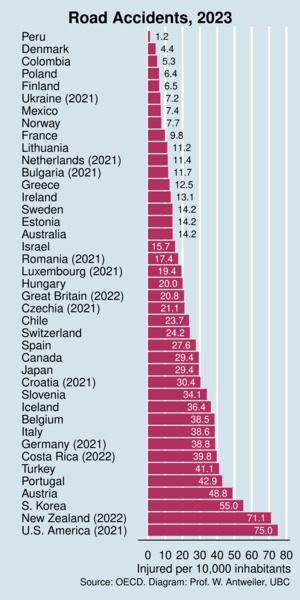
Road safety varies dramatically across countries. And Canada isn't exactly the safest place to drive a motor vehicle or enter traffic as a pedestrian or cyclists. Canada still has a long way to go to catch up to the top of the league in road safety.
The chart on the right shows how many injuries there are through road accidents per 10,000 people. This number is not adjusted for annual mileage, or how many licensed drivers there are. Canadians tend to drive more than most Europeans. But even with adjustments, Canada's road safety picture is disconcerting. In 2023 there were 294 injuries per 100,000 people in Canada. That's much better than in the United States where the injury rate is two and a half times higher. But the rate in Denmark is just 44 injuries per 100,000 people; that's just 15% of the injury rate that we see in Canada. Why can't Canada do as well as Denmark?
And within Canada, British Columbia is only slightly better than the national average. Road safety data from the government of B.C. shows that there were 315 fatalities in 2023. That is 5.7 fatalities per 100,000 people, and 234 injuries per 100,000 people.
Making our streets safer is not rocket science. But it takes political will, infrastructure improvements, and a bit more enforcement too. But let us start with the "low hanging fruit" of where changes can be made: modifying the operation of our traffic lights. One intervention comes at little or no cost: introducing Leading Pedestrian Intervals (LPI) at busy intersections with a high proportion of left and right turns.
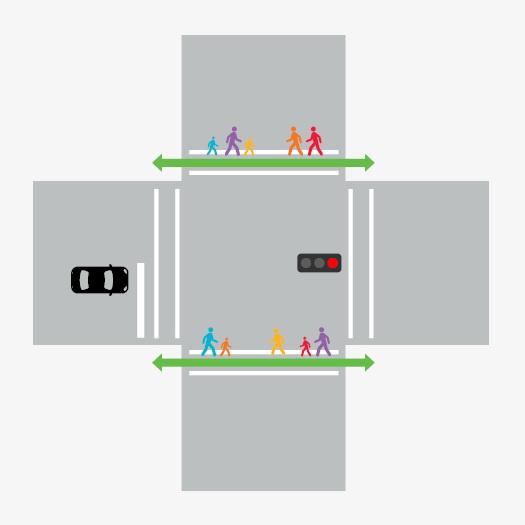
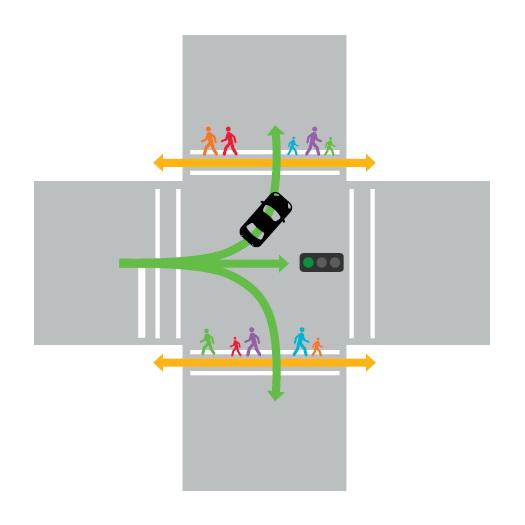
The City of Surrey in British Columbia has embraced a Vision Zero philosophy for road safety: reduce traffic fatalities to zero. Part of their program is the use of LPI. How does it work? I borrow two diagrams from their program web site to illustrate how LPI works. At a four-way intersection, traffic in one direction stops at a red light. Pedestrians and vehicles stop proceeding into the intersection in that direction. When the pedestrian push-button is pressed, pedestrians are given a seven second head start to enter the intersection. Vehicles continue to be shown a red light during this time. After seven seconds, through and left turning vehicles are given the green light to go. Pedestrians are now more visible to drivers and turning vehicles must yield to those already in the crosswalk. LPI can be enhanced further by prohibiting right turns during a red signal. Motorists benefit from this arrangement too. When they are allowed to proceed, pedestrians are well on their way to clear the intersection. The cost to motorists is a slight reduction in the traffic flow. But the overall benefit is well worth the while, as research shows.
Surrey uses seven-second LPI, but perhaps even shorter periods such as four-second LPI are sufficient for pedestrians and cyclists to be more visible in an intersection.
Changes to traffic light operations can yield other benefits. One of the most problematic features of many traffic lights in British Columbia are left turns at the end of a green cycle. When you enter an intersection on a green light to turn left, you are legally permitted—and expected—to complete your turn even after the signal turns red. You must yield to oncoming traffic and pedestrians before finishing the turn. In practice, many motorists complete a left turn after a signal turns red when opposing traffic is dense. Typically one or two vehicles can complete such a "late left turn". Collisions happen easily in such a situation because opposing traffic may run a red light. Too many motorists ignore yellow signals or see a yellow signal as an invitation to speed up to get through an intersection at the last moment. Fatal "T-Bone" (side impact) collisions can occur. Late left turns are stressful for motorists even in the best of conditions. At busy intersections where late left turns are common, traffic light operations should be changed to have dedicated phase-separated left-turn signals. Upgrading traffic lights in this manner requires investments. Where they make the most sense is where there is statistical evidence of frequent left-turn collisions in the past.
There are also numerous intersections where a simple prohibition for right-turn on red (RTOR) can improve road safety. In most European countries (as well as Quebec) RTOR is prohibited. Prohibiting RTOR at signalized intersections lessens simultaneous road user movements, reducing all types of intersection conflicts and crashes.
My call to city administrations everywhere in urban areas is: learn best practice from each other. Introduce LPI and dedicated left-turn signals wherever the data justifies the change. These measure are neither difficult, nor particularly costly, nor politically unpopular. Let's start saving more lives and preventing more injuries.
Further readings:
- Aaron C. Fayish and Frank Gross, Safety Effectiveness of Leading Pedestrian Intervals Evaluated by a Before-After Study with Comparison Groups, Transportation Research Record, 2010, pp. 15-22.
- Elissa Goughnour et al., Evaluation of Protected Left-Turn Phasing and Leading Pedestrian Intervals Effects on Pedestrian Safety, Transportation Research Record, 2021, Vol. 2675(11) 1219-1228.
- David F. Preusser et al., The effect of right-turn-on-red on pedestrian and bicyclist accidents, Journal of Safety Research, 13(2), Summer 1982, 45-55.
- B.C. Community Road Safety Toolkit, Module 2: Safe Roadway Designs to Protect All Road Users, March 2018.
![[print]](print.png)
Recent Blog Entries
- British Columbia's public debt situation is precarious (September 27)
- Canada's sovereignty is not for sale (August 25)
- Should data centres provide demand flexibility to protect BC's electricity grid? (June 8)
- Wind power is growing in British Columbia (June 5)
- Canada needs better rail, but not high-speed rail (June 2)
- How are Canada's electric vehicle imports trending? (May 9)
- The 2026 oil shock may become larger than you think (April 30)
- Improving road safety and saving lives with Leading Pedestrian Intervals (April 2)
- Where are BC's LNG exports sailing to? (March 27)
- Driving electric has become much more beneficial (March 17)
- Today's ruling by the U.S. Supreme Court won't end Trump's trade wars (February 20)
- America's Federal Reserve must stay independent (January 13)
Topics
Months
Subscribe to RSS feed 
![[Sauder School of Business]](logo-ubc-sauder-2016.png)
![[The University of British Columbia]](logo-ubc-2016.png)