BC Hydro announced the winners of its 2025 Call for Power, which follows last year's call for power that I wrote about in my December 2024 blog British Columbia gets more power. BC Hydro will add even more wind farms to its generation portfolio in cooperation with independent power producers and their First Nations partners. Four bids won the competition, and one of them—the Nicola Wind Project—will become the largest wind farm in Canada with 496 MW nameplate capacity.
| Project | Size [MW] |
Location | First Nations Partner |
|---|---|---|---|
| Bessie Wind Project | 251 | Dawson Creek | West Moberly First Nations |
| Nicola Wind Project | 496 | West Kelowna | Upper Nicola Band |
| Sweetwater Wind Project | 210 | Dawson Creek | West Moberly First Nations |
| Taylor South Wind Project | 201 | Taylor | Saulteau First Nations |
In total, 1,158 MW of nameplate capacity will be provided by the four wind farms, for a total expected output of 3,500 GWh. This implies an expected utilization rate of 34.5%. The remuneration for the power producer's output will follow the same time deliver factor arrangement that I discussed in my December 2024 blog How BC Hydro incentivizes independent power producers.
| Quarter | Cost [$mio] |
Energy [GWh] |
Avg. Price [$/MWh] |
|---|---|---|---|
| 2024Q1 | 325 | 2,450 | 132.65 |
| 2024Q2 | 282 | 3,742 | 75.36 |
| 2024Q3 | 377 | 3,847 | 98.00 |
| 2024Q4 | 346 | 3,098 | 111.68 |
| 2025Q1 | 252 | 2,233 | 112.85 |
| 2025Q2 | 348 | 4,118 | 84.51 |
| 2025Q3 | 390 | 4,026 | 96.87 |
| 2025Q4 | 360 | 3,262 | 110.36 |
The table on the left shows B.C. Hydro's power purchases over the last eight quarters, covering calendar years 2024 and 2025, as obtained from financial reports. I had reported a longer time series in my 2024 blog. Quarterly energy purchases eclipsed 4,000 GWh during the second and third quarter of 2025, with purchase prices around $85-$113/MWh.
B.C.'s electricity demand is growing somewhat faster than expected. Overall, electricity demand is expected to grow by about 15 percent by 2030, driven by a combination of population growth, new industrial activity, and the shift to clean energy. BC Hydro submitted its new 2025 Integrated Resource Plan to the BC Utilities Commission last December. The Calls for Power 2024 and 2025 at substantial new generation capacity in coming years. Furthermore, BC Hydro plans to add a sixth generating unit at the Revelstoke Dam, increasing capacity by 500 megawatts. Upgrades to units 1 through 5 of the Shrum Generating Station at the W.A.C. Bennett Dam, pictured below, will add yet another 100 capacity.
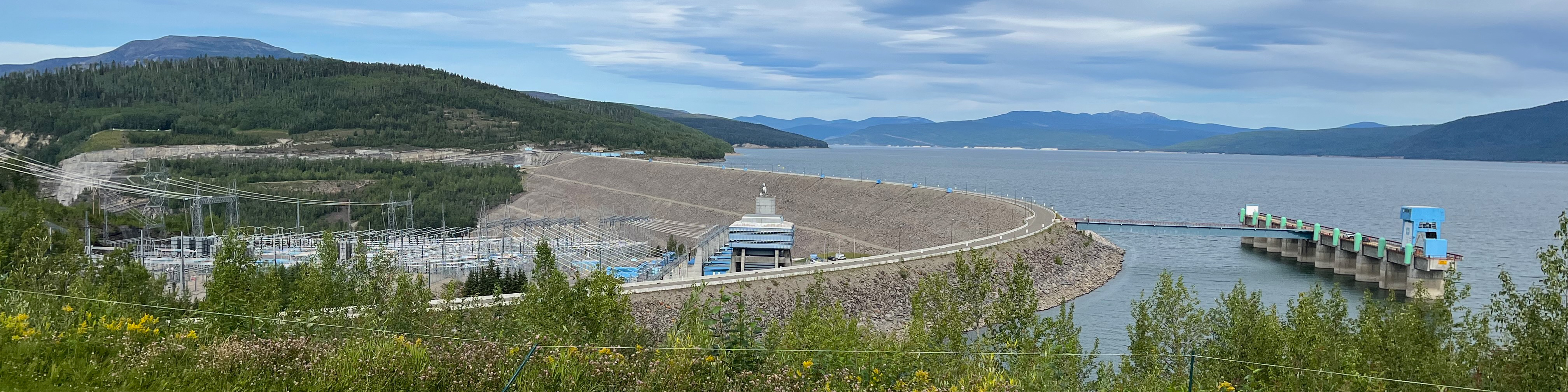
Image Credit: Werner Antweiler
How much more electricity demand will come from which source will be rather important going forward. New data centres can draw significant power. Take for example the proposed two Telus data centres in Vancouver, which together will draw some 126 MW of power. Modern AI data centers operate at a near-constant 85% to 95% utilization of their contracted electrical capacity. This translates into about 990—GWh/year of electricity demand.
Two data centers using up close to one Terawatthour [TWh] over the course of a year is no small amount. Look at the table below to see how much electricity BC was producing over the last three years. Total supply in 2025 was 67.3 TWh, so 1 TWh is about 1.5%. These are non-negligible additions to demand. (Telus is said to have 85 MW capacity secured from BC Hydro [source] so far; the entire clulster is to grow to 150 MW by 2032).
| Year | Average Load [GW] |
Annual Output [TWh] |
Maximum Load [GW] |
Maximum Load [Hour] |
Minimum Load [GW] |
Minimum Load [Hour] |
|---|---|---|---|---|---|---|
| 2023 | 7.35 | 64.38 | 10.73 | Feb 24, 09h | 5.08 | Jul 26, 04h |
| 2024 | 7.57 | 66.49 | 12.33 | Jan 12, 18h | 5.30 | Sep 10, 04h |
| 2025 | 7.68 | 67.29 | 11.36 | Feb 3, 18h | 5.36 | Jun 4, 04h |
The other major industrial demand source will come from proposed liquefied natural gas (LNG) terminals, such as the Ksi Lisims project with 12 million tonnes per year (MTPA) capacity. At first, this project would run its electric drives on power provided by temporary natural gas generators. According to a report from GE Vernova, Decarbonizing the LNG industry: Full electric solution for LNG liquefaction trains, the Freeport LNG terminal on Quintana Island in Texas is powered by 675 MW electric turbines for delivering 15.3 MTPA. This provides a useful benchmark: about 45 MW electric capacity per one MTPA of LNG. Ksi Lisims proposed 12 MTPA thus would probably need around 540 MW, which in turn (assuming an 85% utilization rate) translates into about 4,000 GWh/year of electricity demand. That is roughly a 6% addition to BC's electricity demand, and more than the power provided by the four new wind farms.
‘New demand from industrial sources eclipses growing power needs for EV charging.’
And how much power will be needed for charging up our growing fleet of electric vehicles? Consider a typical B.C. motorists driving 12,800 km/year, and a typical EV (allowing for heating the car in the winter) consumes about 0.20 kWh/km; some vehicles are more efficient, and some heavier EVs are lesss efficient. This calculates as 2.56 MWh/year per vehicle. There were about 3.4 million light-duty vehicles on B.C.'s roads in 2024, according to Statistics Canada data. About 5 percent were electric, a total of about 170,000. Let's assume, optimistically, that B.C. can grow its fleet of electric vehicles by 2.0 percent-points per year. That would mean getting to a fleet share of 25% by 2035, which would translate into adding about 68,000 EVs per year. Multiply by 2.56 MWh/year, and this gives 174 GWh/year of power supply that needs to be added each year. This is small fry compared to the new demand from new data centres and new LNG terminals. So don't worry about EVs overwhelming BC's power grid. The real worry should be about rapid growth from industrial sources. And more about managing electricity demand from data centres in my next blog.
![[print]](print.png)
Recent Blog Entries
- Election cartograms for British Columbia (October 4)
- British Columbia's public debt situation is precarious (September 27)
- Canada's sovereignty is not for sale (August 25)
- Should data centres provide demand flexibility to protect BC's electricity grid? (June 8)
- Wind power is growing in British Columbia (June 5)
- Canada needs better rail, but not high-speed rail (June 2)
- How are Canada's electric vehicle imports trending? (May 9)
- The 2026 oil shock may become larger than you think (April 30)
- Improving road safety and saving lives with Leading Pedestrian Intervals (April 2)
- Where are BC's LNG exports sailing to? (March 27)
- Driving electric has become much more beneficial (March 17)
- Today's ruling by the U.S. Supreme Court won't end Trump's trade wars (February 20)
Topics
Months
Subscribe to RSS feed 
![[Sauder School of Business]](logo-ubc-sauder-2016.png)
![[The University of British Columbia]](logo-ubc-2016.png)