British Columbia elected a new government on October 24, 2026. The incoming Conservative government promised to raise the basic personal exemption from $13,216 to $32,000, which would cut provincial income taxes by $1,000 every year for "nearly every working British Columbian", according to the party's election platform. Their costed platform puts the expense of this plan at $2.9 billion. This is a large tax cut that British Columbia cannot afford if at the same time the new government wants to put a lid on the budget deficit and the rising provincial debt. This overly generous tax cut will widen the deficit rather than fix it. The 2026 provincial budget projects a $13.3 billion deficit for 2026-27. The tax cut would increase it by about 21%.
I have re-calculated the numbers to determine if the party's platform provided an accurate assessment of the total cost of the plan. My own calculations put the cost of the plan at $2.8 billion in the first year. Here is how the tax policy works. The basic personal amount (BPA) is a non-refundable credit that is claimed at the lowest tax rate. The provincial budget for 2026 raised that rate from 5.06% to 5.6% for 2026 and later years, and it applies to the first $50,363 of taxable income. Raising the amount by $18,784 to $32,000 is therefore worth at most 5.6% times $18,784, that is $1,052.
There is an important caveat because the low-income tax reduction credit (LITRC) also matters. The 2026 budget raised the LITRC from $575 to $690, and this amount is paid in full below $25,570 of net income and it is phased out at 3.56% until it reaches zero at $44,952. As a result, B.C.'s income tax currently starts at about $25,600. Under the new plan, raising the BPA and combining it with the LITRC means that B.C.'s income tax begins at about $37,000, and employees who can claim CPP and EI contributions see this limit rise even further.
My own calculations take the data from Individual Income Tax Return Statistics (2024 tax year) from Canada Revenue Agency for British Columbia as the starting point. Next I apply the current BC Personal income tax rates. Because 2024 is two years ago, I need to make two adjustments: that income has risen 8% since 2024, and the number of tax filers by 2%. CPP/EI, age, pension and similar credits are approximated as 16% of taxable income up to $70,000; this number is fitted to match CRA's actual tax by income class up to $100,000, with perhaps small errors. For incomes above $100, 000, my calculations likely overstate the tax amount collected because it ignores dividend tax credits and similar items. With these caveats, my calculations yield a cost of $2.812 Billion.
‘Phasing out the benefits of raising the Basic Personal Exemption for high income earners, and eliminating the Low-Income Tax Reduction Credit could help trim the cost of the tax cut from $2.8B to $1.5B.’
The incoming government has made an election promise of raising the BPA to $32,000. It will be difficult to walk back from this. They have also made a promise to not raise taxes—but that perhaps comes with an asterisk. Not raising income taxes overall may allow for tax restructuring, and perhaps the government should reconsider its overly generous promise. In order to follow through on the $32K BPA promise, marginal rates need to be adjusted somewhat to phase out these benefits for higher-income households. Importantly, the low-income tax reduction credit (LITRC) should be eliminated. Its existence leads to a quirky jump in the marginal tax rate. If the new Conservatives wants to press ahead with their election promise, they should modify it along the lines I outline below, reducing the total cost to about $1.525 billion. Still a lofty tax break, and most British Columbians would gain—except for the most affluent. The top marginal tax rate would remain the same. A tax cut is still the wrong direction overall, but I understand that walking back from a promise is politically costly. The table below shows the current and proposed measure, and my alternative.
| Income Bracket / Tax Measure | Tax Rate (2026) |
ConservativeProposal | Proposed Alternative |
|
|---|---|---|---|---|
| BPA | Basic Personal Exemption | $13,216 | $32,000 | $32,000 |
| LITRC | Low-Income Tax Reduction Credit | $690 | $690 | $0 |
| 1. | $0–$50,363 | 5.60% | 5.60% | 7% |
| 2. | $50,363.01–$100,728 | 7.70% | 7.70% | 9% |
| 3. | $100,728.01–$115,648 | 10.50% | 10.50% | 11% |
| 4. | $115,648.01–$140,430 | 12.29% | 12.29% | 13% |
| 5. | $140,430.01–$190,405 | 14.70% | 14.70% | 15% |
| 6. | $190,405.01–$265,545 | 16.80% | 16.80% | 17% |
| 7. | Over $265,545 | 20.50% | 20.50% | 20.50% |
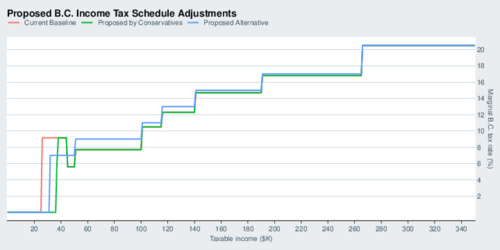
My proposed alternative tax schedule simplifies the marginal tax rate into two-percent increments for the tax brackets, starting at 7%. The last jump is from 17% to 20.5% and lands on exactly the same marginal tax rate as the current rate. (There is actually an argument to be made to lower the last marginal rate from 20.5% to 19%, and introducing a new 21% rate for ultra-high incomes above $500,000.)
The diagram below shows the marginal tax rates under the three scenarios. The green line for the Conservative's plan retains the same quirky jump in the marginal rate because of the LITRC. Then the green and orange lines overlap. My proposal is captured by the blue line.
click on image for high resolution PDF version
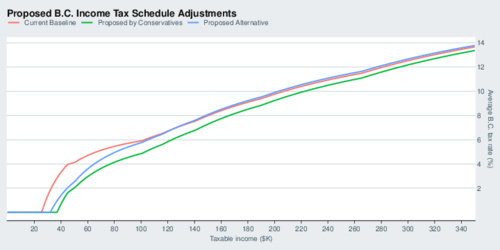
The next diagram shows the average tax rates. My proposed adjustments track back to the existing schedule near $100,000.
click on image for high resolution PDF version
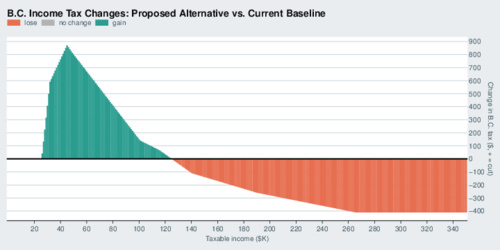
The Conservatives' plan is quite simple: everyone gets about $1,052 as a tax cut—without tapering off for high-income households. My plan below creates mostly winners, but a few rich households are a little less well off—those that can easily afford it. The diagram below shows that the peak tax break reaches about $800 for low-income households and tapers off towards $120,000. Above $120,000 income, there would be net tax increase of up to $400, but never more than $400. Keep in mind, though, that the vast majority of tax payers have incomes well below $100,000.
click on image for high resolution PDF version
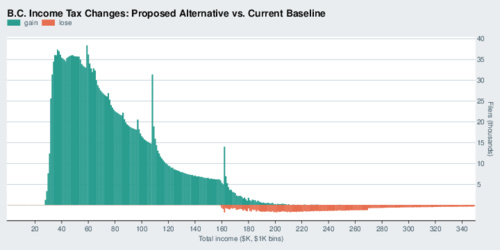
The next chart shows that my revised plan would benefit the vast majority of B.C. tax payers. The diagram shows the number of tax files in thousands who would gain (in green) or lose (in red). As you can see, the number of tax filers who gain is vastly larger. Many people even gain with incomes above $100,000 because of various tax credits. The diagram above only shows the nominal shift, but without applying the adjustments. Ignore the spikes in the diagram; they are an artifact of the bracketing of income filer information by CRA. There are misalignments right at the tax bracket boundaries due to the sampling method that is used.
click on image for high resolution PDF version
I would maintain that my proposal is eminently more sensible than the Conservatives' undiluted plan. At a cost of $1.5B, it comes at 54% of the $2.8B of the Conservative plan. It will still enlarge the deficit, but at a more manageable pace. Conservatives will cringe at the notion of making the rich pay a little more, but it helps lower the cost of the plan and facilities helping middle-income families. There is no compelling reason to lower taxes for high-income households, especially in light of the fact that the carbon tax has been eliminated as well, which benefits high income households more than low-income households (who have also lost the related tax rebates). Why not make the tax system fairer along with the tax cut?
‘With a lavish tax cut BC's new government is about to paint itself into a corner: one of fiscal profligacy rather than stewardship.’
The best way forward would be to suspend the promised tax cut until after the deficit has been eliminated. But what are the chances for responsible fiscal stewardship? It appears that BC's NDP and Conservatives both are eager to raise the deficit, but are not eager to balance the books. As I have argued studiously in my previous blog about B.C.'s public debt, fixing the budget deficit requires both revenue increases and expenditure decreases. Both sides must contribute. The real political question is about which side will do more of the heavy lifting: revenues or expenditures? The new Conservative government has painted itself into a corner of fiscal profligacy, not fiscal stewardship. My counter-proposal above is an exercise in fiscal damage control. It is not too late for the new government to say: the fiscal situation we inherited is too dire, we need to be more cautious now, and leave the second half of the tax cut for a later point closer to the next election.