Yesterday, British Columbia elected a Conservative government. Election night results have the Conservative Party with a clear majority of 64 seats, the NDP with 27 seats, and the Green Party with two seats. Two weeks ago I introduces new election cartograms for British Columbia that visualize election outcomes by representing each constituency with a hexagon, roughly in geographic proximity to each other, but correcting for the vast differences in geographic size. Below are the new election cartograms with the results of yesterday's election.
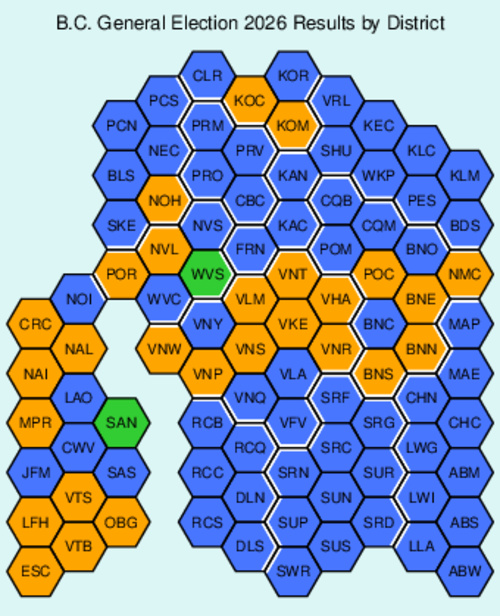
click on image for high-resolution PDF version
Burnaby-Coquitlam:
BNC Burnaby Centre; BNE Burnaby East; BNN Burnaby-New Westminster; BNO Burnaby North; BNS Burnaby South-Metrotown; POC Port Coquitlam; POM Port Moody-Burquitlam; CQB Coquitlam-Burke Mountain; CQM Coquitlam-Maillardville; NMC New Westminster-Coquitlam.
Cariboo:
CBC Cariboo-Chilcotin; PRM Prince George-Mackenzie; PRO Prince George-North Cariboo; PRV Prince George-Valemount.
Fraser Valley:
ABM Abbotsford-Mission; ABS Abbotsford South; ABW Abbotsford West; CHC Chilliwack-Cultus Lake; CHN Chilliwack North; LLA Langley-Abbotsford; LWG Langley-Walnut Grove; LWI Langley-Willowbrook; MAE Maple Ridge East; MAP Maple Ridge-Pitt Meadows.
Interior:
BDS Boundary-Similkameen; PES Penticton-Summerland; VRL Vernon-Lumby; WKP West Kelowna-Peachland; SHU Salmon Arm-Shuswap; FRN Fraser-Nicola; KAC Kamloops Centre; KAN Kamloops-North Thompson; KEC Kelowna Centre; KLC Kelowna-Lake Country-Coldstream; KLM Kelowna-Mission.
Kootenays:
CLR Columbia River-Revelstoke; KOC Kootenay Central; KOM Kootenay-Monashee; KOR Kootenay-Rockies.
North:
BLS Bulkley Valley-Stikine; PCN Peace River North; PCS Peace River South; SKE Skeena; NEC Nechako Lakes; NOH North Coast-Haida Gwaii.
North Shore:
POR Powell River-Sunshine Coast; WVC West Vancouver-Capilano; WVS West Vancouver-Sea to Sky; NVL North Vancouver-Lonsdale; NVS North Vancouver-Seymour.
Richmond-Delta:
RCB Richmond-Bridgeport; RCC Richmond Centre; RCQ Richmond-Queensborough; RCS Richmond-Steveston; DLN Delta North; DLS Delta South.
Surrey:
SRC Surrey City Centre; SRD Surrey-Cloverdale; SRF Surrey-Fleetwood; SRG Surrey-Guildford; SRN Surrey-Newton; SUN Surrey North; SUP Surrey-Panorama; SUR Surrey-Serpentine River; SUS Surrey South; SWR Surrey-White Rock.
Vancouver:
VHA Vancouver-Hastings; VKE Vancouver-Kensington; VLA Vancouver-Langara; VLM Vancouver-Little Mountain; VNP Vancouver-Point Grey; VNQ Vancouver-Quilchena; VNR Vancouver-Renfrew; VNY Vancouver-Yaletown; VNS Vancouver-South Granville; VNT Vancouver-Strathcona; VNW Vancouver-West End; VFV Vancouver-Fraserview.
Vancouver Island:
OBG Oak Bay-Gordon Head; VTB Victoria-Beacon Hill; VTS Victoria-Swan Lake; SAN Saanich North and the Islands; SAS Saanich South; CRC Courtenay-Comox; CWV Cowichan Valley; ESC Esquimalt-Colwood; JFM Juan de Fuca-Malahat; LAO Ladysmith-Oceanside; LFH Langford-Highlands; MPR Mid Island-Pacific Rim; NAI Nanaimo-Gabriola Island; NAL Nanaimo-Lantzville; NOI North Island.
The chart below shows which seats changed hands: a cluster of four ridings on Vancouver Island, and wave of ridings across Richmond, Delta, parts of Vancouver and Burnaby, Surrey, Maple Ridge, Port Coquitlam. These are mostly ridings that straddle urban and suburban areas, and are natural "battleground" ridings. With the swing in the popular vote, these flipped from the NDP to the Conservatives. Curiously, one riding (Courtenay-Comox) flipped to the NDP, but with less than 700 votes difference.
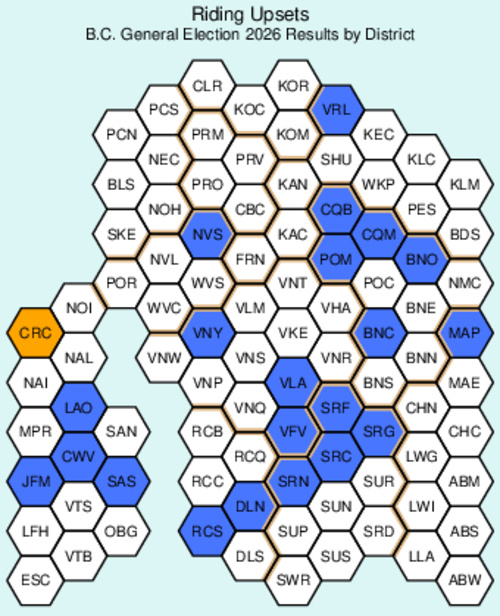
click on image for high-resolution PDF version
A first-past-the-post system exaggerates relative strengths of political parties, and thus the last diagram below shows the "true" colour of British Columbia. with orange and blue and green mixed in proportion the the parties' strengths. The colour shades remain more nuanced, and especially Vancouver Island remains much lighter coloured than other parts of the province. Vote splitting among progressive voters favoured the Conservative Party, quite in reverse what NDP tactitians anticipated with vote splitting among the right between Conservatives, Centre BC, and One BC. Instead the right-of-center vote consolidated behind the Conservatives convincingly. Voters clearly preferred a clear alternative to the incumbent government and handed the Conservative Party a strong mandate.
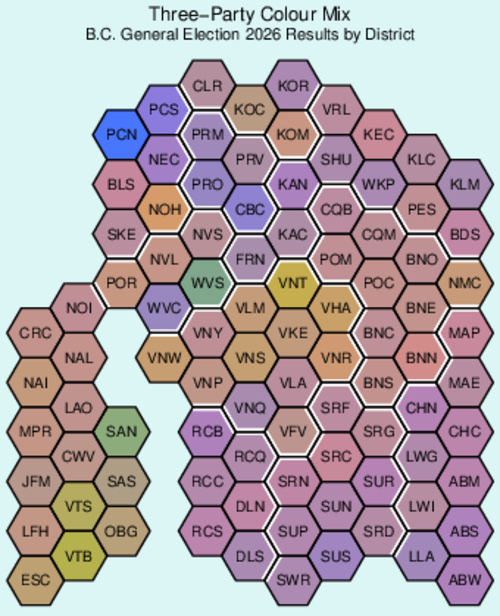
click on image for high-resolution PDF version
Despite the blue wave, British Columbia remains more divided than the election result suggests. If British Columbia had a proportional representation system, the vote would have gone 46-36-11 for Conservatives, NDP, and Green Party (using the modified Saint-Laguë method), or 47-36-10 (using the d'Hondt method). In the former the Green Party would have held the balance of power. The parties gained 48.1%, 37.4%, and 11.0%, with 1.6% and 1.5% going to other parties on the right of the political spectrum. That makes a rough 51.27ndash;48.4% vote split in the province. While Conservatives have a strong mandate to govern, the election outcome has been helped much by the electoral system. The large seats share in the Legislature will give fringe voices in the Conservative Party less leverage, which should allow the new Premier Lorne Doerkson to focus on policy-making and less on party infighting. The incoming government faces strong headwinds fiscally, and costly promises made in the election platform are not helping to bring down British Columbia's deficit and worrisome fiscal situation, which I had written about in September.

Recent Blog Entries
- British Columbia's new electoral map (Oct 25)
- Election cartograms for British Columbia (Oct 4)
- British Columbia's public debt situation is precarious (Sep 27)
- Canada's sovereignty is not for sale (Aug 25)
- Should data centres provide demand flexibility to protect BC's electricity grid? (Jun 8)
- Wind power is growing in British Columbia (Jun 5)
- Canada needs better rail, but not high-speed rail (Jun 2)
- How are Canada's electric vehicle imports trending? (May 9)
- The 2026 oil shock may become larger than you think (Apr 30)
- Improving road safety and saving lives with Leading Pedestrian Intervals (Apr 2)
- Where are BC's LNG exports sailing to? (Mar 27)
- Driving electric has become much more beneficial (Mar 17)
Topics
Months
Subscribe to RSS feed